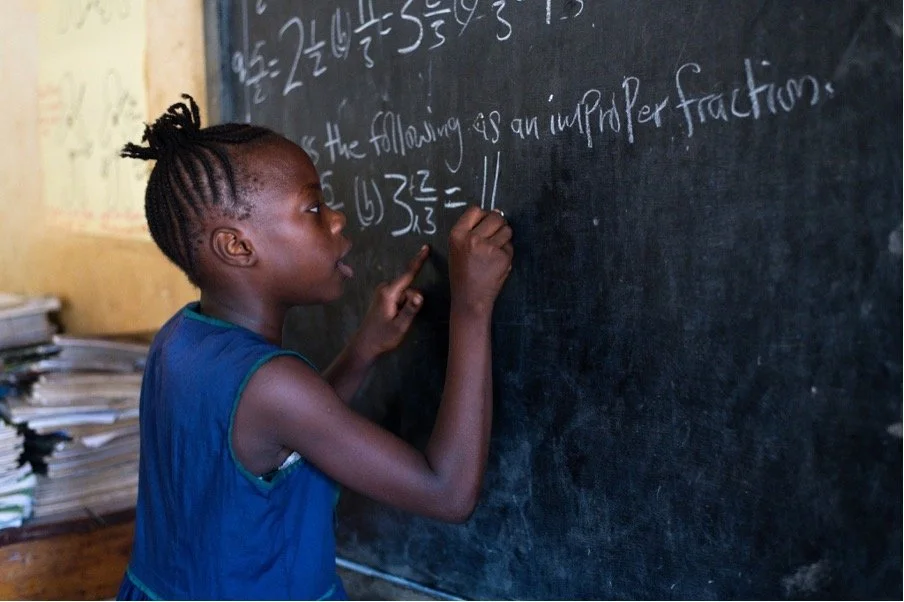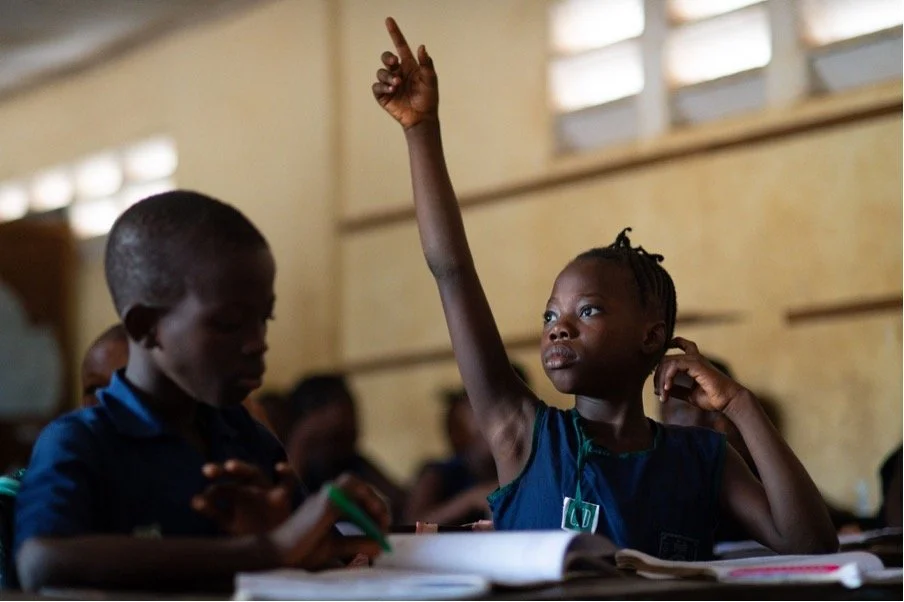
At Rising, our work on girls’ education begins with the foundations of a good school system: strong teaching, clear classroom routines, safe and well-managed schools, regular coaching, and better use of learning data. We work with governments to strengthen those everyday conditions because they matter for all children, and often especially for girls, who are more likely to have experienced interrupted schooling, late entry, inconsistent attendance, or fewer opportunities to participate fully in class.
The earliest evidence came from Sierra Leone
The strongest and longest-running evidence comes from Sierra Leone, where Rising has worked for more than a decade. A three-year longitudinal study conducted by the University of Oxford found that students in Rising’s private schools made between 48% and 160% more progress than peers in comparable private and government schools, depending on the subject and comparison group. Within those already strong results, girls saw especially large gains: they advanced faster than boys in Rising schools, and between two and four times faster than girls in comparison schools. In mathematics, the proportion of girls reaching benchmark rose from 5% to 40% over the course of the study.
Those findings sit alongside a longer track record in Sierra Leone. Rising’s private schools have consistently outperformed national averages in public examinations at both primary and junior secondary level, including 100% pass rates in recent examination cycles. Girls have been central to that success, equalling or slightly outperforming boys in Rising schools at a time when girls nationally tend to perform slightly below boys.
The pattern has since emerged in public systems too
More recent evidence from the Sierra Leone Education Innovation Challenge (SLEIC) suggests that these gains can hold inside a government-led public education reform. SLEIC is a flagship outcomes-funded program of Sierra Leone’s Ministry of Basic and Senior Secondary Education and the Education Outcomes Fund. In the final evaluation, led by Oxford Policy Management, Rising-supported public primary schools were the strongest-performing provider group overall out of five providers, with effect sizes of 0.384 standard deviations in mathematics and 0.291 in English.
Girls’ results within SLEIC were particularly striking. Rising delivered the largest mathematics gains for girls across all five providers, and was the only provider to deliver large, statistically significant gains for girls in English. In Rising-supported schools, girls outperformed boys in both subjects. In mathematics, the proportion of girls meeting the minimum standard rose from 20.3% at baseline to 43.8% by Year 3.
This matters because it suggests that strong gains for girls are not confined to Rising’s own schools. They can also be achieved in public schools through partnerships designed to strengthen the quality of teaching and learning across a government system.
In Liberia, the picture widened beyond learning gains alone
In Liberia, Rising’s FasterReading program has added another dimension to the picture. Evaluated by IDinsight, the program improved foundational reading skills for overage early childhood students by 36%, equivalent to 0.28 standard deviations, over and above teaching as usual. It also found a meaningful attendance effect: students in the program were 11% more likely to attend school overall.
For girls specifically, the attendance findings were especially encouraging. Girls participating in FasterReading were 8.9 percentage points more likely to be present during independent attendance checks than girls in the control group. Among girls who completed the full five-cycle program, that figure rose to 11.4 percentage points.
Why might girls be benefiting so strongly?
In many of the contexts where Rising works, girls face a compounding disadvantage. They are more likely to have started school late, more likely to have experienced interrupted attendance, and less likely to have received the same encouragement to participate actively in class. A model built around structured lessons, regular assessment, coaching, and teaching at the right level may be particularly valuable in those contexts because it helps teachers notice when children are behind and support them to catch up.
This is consistent with wider evidence in the field. Evans and Yuan’s 2019 review of education interventions across low- and middle-income countries found that broad-based approaches can deliver strong gains for girls when they improve pedagogy and help teachers respond to where learners actually are, rather than where they are assumed to be. Stronger safeguarding and school management matter too. Girls are more likely to attend and remain in school when they feel safe, when expectations are clear, and when school feels like a place where they belong.
Building on this progress
Rising is now building on this learning through a growing set of government partnerships across countries including Ghana, Rwanda, Sierra Leone and Liberia. As these partnerships scale, the opportunity is not only to reach many more girls through public education systems, but also to deepen Rising’s understanding of what helps girls who have experienced interrupted schooling, late entry, inconsistent attendance or weaker foundational skills to catch up and thrive.
The next phase of the work will involve looking more closely at girls’ outcomes across these partnerships, not only in terms of learning gains, but also attendance, retention and re-engagement. Over time, this will help Rising build a clearer evidence base for how girls benefit from its wider school-improvement model, and where additional support may be needed for girls who are starting furthest behind.