Blog Post: "That’s just how we work."
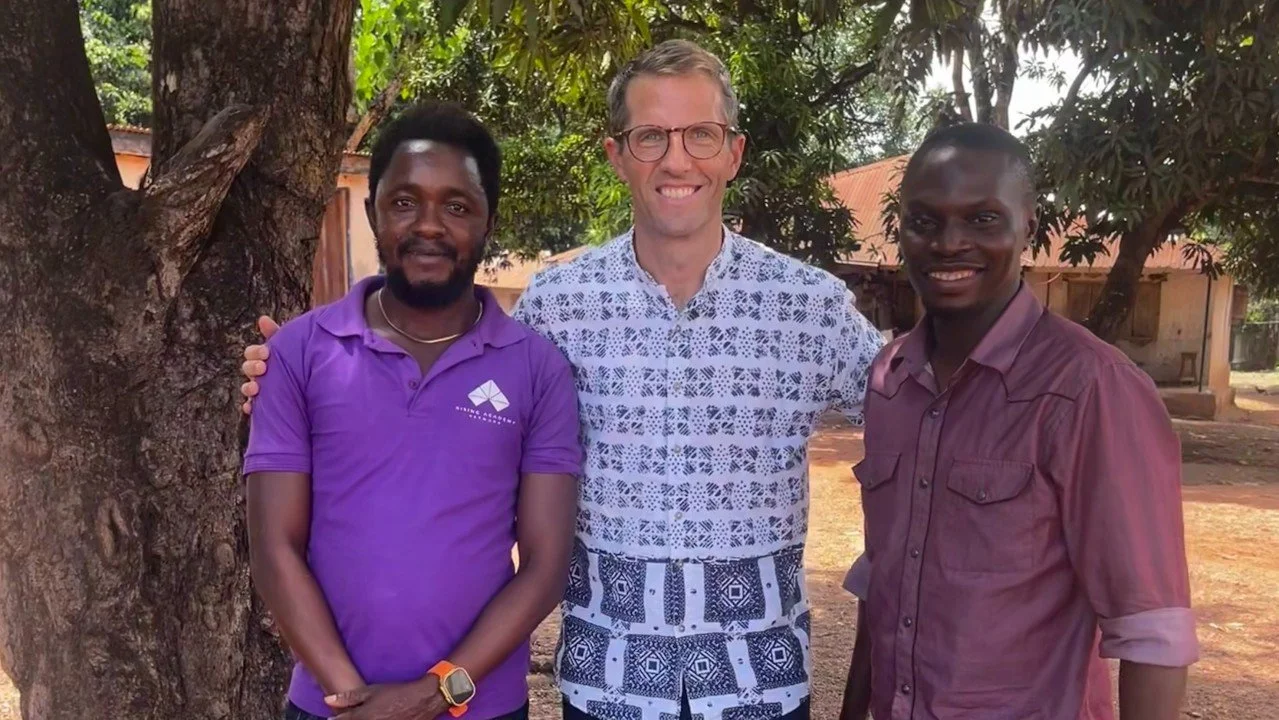
Pablo, Paul and Alfred after visiting SLEIC schools in Sierra Leone
A blog post from Rising’s Co-Founder and Executive Chairman, Paul Skidmore.
Meet Pablo and Alfred, two of our most experienced and skilled coaches at Rising Academies. Both these guys are Rising veterans. They started as teachers in our own private schools in Freetown, rapidly progressing into school leadership roles. As we expanded our work in Sierra Leone to include partnerships with the government to improve public schools, and particularly when the Sierra Leone Education Innovation Challenge kicked off under the auspices of the Ministry of Basic and Senior Secondary Education and The Education Outcomes Fund 3 years ago, they took on senior roles in our field team, overseeing our school coaches, engaging communities and government stakeholders, and working directly with schools themselves.
In my final weeks before stepping down as Rising's CEO last year, I got the chance to spend the morning visiting schools and watching them in action with pupils, teachers, school leaders and district staff. After the final visit of the day, we sat down in the shade of a tree in the playground and talked for almost two hours about their experience.
Reflecting on the recent SLEIC #RCT results, three key themes of our conversation that day feel particularly relevant:
1. Learning While Scaling.
Coaching has always been a fundamental pillar of our model at Rising. High quality teacher guides and student materials create the right floor, but coaching helps raise the ceiling. Like many organisations, we've been on a journey when it comes to figuring out the right "dose" and focus for coaching.
At very small scale we could put a great coach in every school (and we did - this was the role where folks like Pablo and Alfred cut their teeth).
But as we grew, and particularly as we started to work in very rural, very low resource settings, placing a good coach in every school proved impossible. At the same time, there were now far too many schools for our central team to visit with any frequency.
In the next iteration of our model we therefore moved to a roving model, with each coach taking on a cluster of schools that they would visit every week or every other week. And we expanded their remit, with more emphasis on collecting data, conducting observations, making judgements about performance and generally being our eyes and ears on the ground. This change in scope was reflected in a change in title: we called them “School Performance Managers”.
There was just one problem: it wasn’t really working. One warning signal was an RCT where we experimentally varied the “dosage” of coaching: some schools got frequent visits from a coach, some got occasional visits, and some got none. Some coaching was better than none, but on most indicators more intensive coaching didn’t deliver better outcomes. Not a good sign. We were also seeing inconsistencies between the judgments our coaches were recording about schools and what was coming through in other data.
To understand these discrepancies, we spent more time with coaches on their visits; when we did, a few things jumped out. One was the variation in what different coaches ‘saw’. The best had an uncanny intuition for what was right and what was off the moment they walked into a school. But no matter how much we tried to codify this intuition in rubrics or training curricula, we couldn’t consistently get the median coach to that level. The second was that in our embrace of a more data-driven approach, something important had been lost. Instead of being 'in the arena' with teachers and school leaders, too often our team was watching from the sidelines. There was a distance that hadn't been there previously. Before, if they encountered a teacher getting horribly confused with a lesson plan, or mispronouncing the letter sounds in that day’s phonics lesson, they would step in and have a discreet word in the teacher’s ear or do some artful team teaching to get the lesson back on track. Now, instead, they would note it down in a report. Maybe the teacher would get the feedback eventually, but the power and immediacy was lost.
So a few years ago, we overhauled our coaching model to try to recover some of that initial, hands-on, collaborative spirit. We simplified the data we were asking coaches to collect, and used other sources of data (particularly from student assessments) to build a more rounded picture of how schools were doing. We changed the way we trained coaches to foreground a culture of, as one of our Board Directors Zenna Hopson has put it, “doing good as you go”. And we scrapped the term School Performance Manager and changed the job title to Coach to encapsulate this shift.
In my visits with Pablo and Alfred that morning, I saw them model a whole variety of different approaches to the coaching role, some more hands-off, some more hands-on, but all undergirded by high levels of trust and rapport with the teachers they were working with. Like everything we do, it’s still a work-in-progress - “however well we do, we always strive to do better”, as we like to say - but in the hands of people like Pablo and Alfred, I feel like we’re much closer to scaling a coaching model rooted in the power of trusted relationships.
2. The power of (the right) data
Everyone likes to talk about being data-driven. We don’t talk enough about how hard that is if the underlying public data infrastructure is still nascent, and when lots of things that in other systems would be readily available in routine public administrative data either don’t exist or aren’t reliable. GPS coordinates that place schools in the wrong place. Schools that are coded as public when they’re actually private. Schools that keep two sets of enrolment data - one set to make sure they max out their entitlement to the per pupil capitation grant they receive, and an unofficial set that actually captures the children who routinely attend the school. Three in four teachers not on the formal government payroll file. A lack of timely, reliable data on learning outcomes.
Three takeaways from that:
First, if you want to be data-driven, you may need to build the data infrastructure yourself. This takes time and money.
Second, once built, it can be hugely powerful. In the case of SLEIC, for example, it allowed Pablo, Alfred and our other coaches to move away from a one-size fits all approach in favour of a more differentiated strategy that met schools where they are and adapted the scope and intensity of our support to fit what schools and school leaders were ready and willing to take on.
Third, because it is both costly and valuable, in an ideal world it would be preferable to amortize this investment in data and relationships over many years. This is what makes the perennial “project-itis” - the tendency to organize education system reforms into one, two or three year projects - so frustrating. I'm grateful that in this case our government partners in MBSSE and our funders are enabling our work to endure beyond the end of the SLEIC itself. Too often relationships and data infrastructure that have been painstakingly built are allowed to wither on the vine.
3. The Whatever It Takes mindset
In the global education debate, there's a growing and very welcome focus on following the evidence and "the science of learning". But to be applied effectively, the science of learning needs the alchemy of relationships.
When you talk to Pablo and Alfred, they understand this instinctively. There’s what the implementation plan and the contract with the government says - and then there’s what is actually required to make change happen. Here are just a few examples:
One SLEIC school they were assigned was a dilapidated corrugated metal shack. When it rained, it was completely unusable, and when it wasn’t raining, jagged sections were peeling off to expose sharp edges that were a huge safety risk to students. Through diplomatic but persistent nudging, cajoling, galvanising and lobbying - and by giving them hope that it would be worth it - our team persuaded the local community to find the resources and mobilise the sweat equity to construct a new building.
At another school, a land dispute between two local groups turned nasty, and parents were keeping children at home for their own safety. Our team stepped into mediate it.
In a third community, a girl ran away from home and stopped showing up at school, and neither her parents or the school knew where she was. Our team used the quality of their relationships in the school to find out from friends where she was, and negotiate with the student and her family to reunite her safely.
None of this is in the contract. None of it is in their job description. When I asked Pablo why he did this, he went back to the values that had been instilled in him in Rising's early days during and after Ebola. “That’s just how we work at Rising,” he said. “We do more than anyone thought possible with less than anyone thought possible”.
As a founder, it’s quite something to spend time with staff members who are such incredible ambassadors for your organisation's culture and values. But it's even more special to see, with this set of results, what living by these values has enabled them to accomplish. They should be very proud.